Monday, September 14, 2009

Chisolm


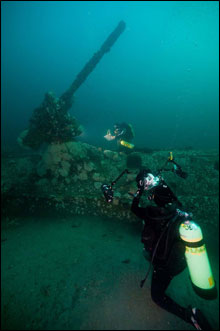
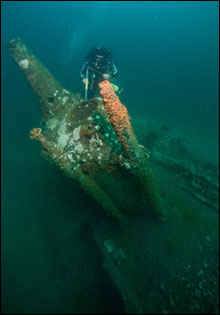
Isle Royale National Park, Michigan - Chisolm, a bulk freighter built of wood, was built in 1880 and ran aground in the predawn hours of October 20, 1898. Large sections of the wooden hull lie scattered among the Cumberland wreckage on a reef not marked by the Rock of Ages Lighthouse. This site features an intact steam enging with drive shaft and propeller sitting in about 140’ of water. The double expansion steam engine stands about 20 feet tall an
d is near perfect condition framed in ornate iron work. The engine has two pistons, one 30" and the other 56" in diameter, that operated with a four foot stroke. - Steve Martin, ISRO Picture of the Day.
Chisolm is my favorite site in the park. This massive expansive steam engine is difficult to describe it is so remarkable. The size is the first thing one marvels, but on closer examination the ornate designs crafted out of steel that surround the engine are the most remarkable. The craftsmanship involved to create such artistry in a location that no one will ever see is amazing to me. Once you rebound from the engine, one can swim along the perfectly intact prop shaft out to the propeller. Again, size is the prominent feature. Along the i
ntact stern you can observe the water marks cut into the wood in roman numeral are visible.

Saturday, September 12, 2009

Emperor

Emperor was a 525' steel bulk freighter carrying a load of iron ore. It was built in Canada in 1907, and met its demise in the early morning darkness of June 7, 1947. Principal blame was placed with the First Mate for not keeping "proper watch". This was further qualified, saying that the prevailing system, required him to be in charge of loading when he should have been off-duty resulted in his being overtired from lack of sleep. Out of this came the practice of today's Lake sailors, four hours on, eight hours off, four hours on, eight hours off.
This picture is of a large windlass, used to raise and lower the anchors, and Andres Diaz, an Archeologist with the NPS Submerged Resources Center. This image was taken in about 40-45' of water. -Steve Martin, ISRO Picture of the Day

Tuesday, September 8, 2009

Glenlyon Mosaic


A major goal of this condition assessment is to build on work that was accomplished in the early ‘80s by the Submerged Resources Center and ISRO Dive team. As we apply the same archeological survey techniques used decades ago, we also have the benefit of underwater digital imaging technologies. In this photographer’s opinion, digital photography has been one of the most valuable advancements in underwater survey. The ability to generate hundreds of instantly available images vs. 36 pictures on traditional film has increased the data collection and documentation of these sites dramatically. One technique the SRC has used successfully over the past few years to enhance the interpretive value of shipwreck sites is by stitching several digital images together to create a mosaic. This process offers a view of a site unavailable even to the divers from one static viewpoint limited by visibility. It also has the ability to communicate the massive size and scale of these goliath vessels strewn across the reefs of Isle Royale.

In this mosaic of the Glenlyon shot three days ago, Steve Martin examines the shaft connecting the expansion engine with the broken prop resting on the reef in 45’ of water. This image was created by stitching 34 vertical images together and provides a panoramic viewpoint of the sites most impressive feature. - Brett Seymour, ISRO Picture of the Day

Monday, September 7, 2009

Glenlyon

Glenlyon was a 328’ bulk freighter, built in 1893. It ran aground in the early morning hours of November 1. 1924 while seeking shelter in the Siskwit Bay from fall storms - Steve Martin, ISRO Picture of the Day

The Glenlyon is one of my favorite sites of Isle Royale. The machinery is massive and visually interesting. Its also a site were you can shoot a photograph that “looks” like a shipwreck. Anchors, windlass machinery and huge boilers all communicate shipwreck. Often times with the sites I image, especially the 18th and 19th century sites, its hard to find an iconic shot to communicate shipwreck. Archeologist may get excited about rigging piles and chain plates, but the general public like to recognize a shipwreck. The Glenlyon has no shortage of images to create.

Friday, September 4, 2009

Shipwrecks of Isle Royale

Isle Royale National Park, Michigan –Few location have stir the imagination like Isle Royale National Park. When I first started working with the NPS it was one of those places that held mythical status, much like the USS Arizona Memorial. The thought of all those shipwrecks in one location so well preserved in the cold dark waters of Lake Superior. I have had the opportunity to visit Isle Royale on two separate occations in the past three years. Each project only wetted my appitite to spend more bottom time imaging these massive vessels.


So, I am for two weeks with the federal mandate to conduct condition assments. Basically, this means an archeologist swims around the site and rates the condition of the site with the appropriate terminology and paperwork as poor, fair or good. In addition, they look for impacts, human or natural, and note those as well. What this means for me is bottom time! Hit as many sites as the weather will allow with the talent park dive team from Isle Royale on my absolute favorite dive boat in the NPS – the Lorelei.


Isle Royale Park Dive Officer Steve Martin came up with the great idea to provide the entire Isle Royale park staff with a picture of the day with a brief description of the operation each day. Since I ended generating some of the best shipwreck images I have ever shot, I thought it would be appropriate to post them here as well. I will include the blat that Steve offered up to the park staff regarding the project and perhaps interject some addional prose if appropriate. Enjoy the cold waters of Isle Royale Shipwrecks.

Saturday, August 22, 2009

Diving with Doubilet

The following post is from the NOAA Battle of the Atlantic web site. You can see the orginal, with all the other expedition blogs at:


Mission Log: Aug. 22, 2009

By Brett Seymour
A/V Production Specialist/Diver
National Park Service Submerged Resources Center

Boats and weather - they are a constant battle for anyone who makes their living on (or under) the water. Just as the flotilla of project boats are back on-line, Hurricane Bill skirts up the Eastern seaboard. The Battlefield of the Atlantic crew can only watch the 12-15ft swells make landfall on Atlantic Beach over lunch on Saturday.

As the waves roll in, it gives the team a couple days to catch up on the data wrangling that accompanies any given project. Plotting field drawings on the site map, a much needed wash of the dive gear, and in my case, time to work up the hundreds of images that are generated during each day. My latest batch of photographs was generated on the U-85 late last week. Although Dave Conlin and I had the opportunity to dive the site earlier in the project, on this trip we would be working with one of the greats in underwater photography, David Doubilet.

Dave Conlin (NPS) collects data on the U-85, while National Geographic Magazine Photographer, David Doubilet, takes photos
Dave Conlin (NPS) collects data on the U-85, while National Geographic Magazine Photographer, David Doubilet, takes photos. (Photo: Courtesy of Seymour/NPS/NOAA)
David’s wife, Jen Hayes, had contacted MonitorSanctuary Manager, Dave Alberg after a web hit referencing artificial reefs along with our current project. Although most people assume this term only applies to purposefully sunken vessels for the enjoyment of the dive community, the phrase actually encompasses a much greater collection of submerged resources. In the framework of this project, WWII wrecks also qualify. David and Jen have been working on an article for National Geographic Magazine addressing the topic and requested some time with the Battle of the Atlantic team to generate some images. So it was back to Nags Head, NC for Dave Conlin and I to meet up with David and Jen and charter with Bill McDermott and the Outer Banks Dive Center crew.

I first met David back in back in 2000 on the USSArizona, while the National Park Service Submerged Resources Center was conducting a corrosion study on the 608’ submerged battleship. He was brought in to shoot for an article on the 60th anniversary of the Pearl Harbor attack for National Geographic Magazine. The story examined the current condition of the American icon and the stewardship responsibilities of the National Park Service. For a young underwater photographer eager to learn from the best, the experience was invaluable. There, as with the U-85, his eye for the dramatic was unmistakable and his laidback, yet disciplined approach to creating an image was refreshing.

We met up with David and Jen at the dock and helped them load a small fortune in underwater still cameras and lights. The hour transit to the site gave us the opportunity to catch up and plan what David wanted out of the shoot. During the previous week’s dive, I had created a photo mosaic of the German U-boat, which helped us plan the dive. Immediately David’s finger went to the forward deck gun as the shot. Agreed, I thought to myself. Not placing myself in the same league as David, seeing the shot and creating it are two very different things.

Conlin and I had some project related tasks for the dive, which including lowering a YSI environmental sonde into the open hatches of the U-boat. This instrument collects environmental data about things like dissolved oxygen, pH, salinity, and temperature that will feed into corrosion studies. As we were diving closed circuit rebreathers, our bottom time was easily double the time of David and Jen on standard SCUBA cylinders, so we splashed first.

Dave Conlin (NPS) collects data on the U-85, while National Geographic Magazine Photographer, David Doubilet, takes photos
Dave Conlin (NPS) surveys the conning tower of the U-85. (Photo: Courtesy of Seymour/NPS/NOAA)
As I descended upon the U-85conning tower, I briefly made the connection between the U-boat and the first successful submarine, the HLHunley, that I had imaged not so far down the coast off Charleston, SC. So much history underwater. So many stories to tell. These stories are exactly the reason why I became an underwater photographer in the first place—it’s time to get to work.

A quick check of my rebreather, depth and time and we were off to the stern to place the YSI. We met up with David and Jen 30 minutes into our dive just as planned. Conlin’s task was to accept cryptic hand gestures that are randomly thrown out by underwater photographers when we need the “talent” to move up, over, or simply stay. His years deciphering my hand rants had paid off as he was easily able to comprehend David’s cues. I spent the dive hovering behind David shooting stills while Jen crouched behind the deck gun and lit Conlin with underwater lights.

To be honest, I’m not really sure what I expected watching David shoot underwater. After years of admiring his work, I guess magical rays of sunlight at his beck and call or the ability to usher in a pod of bottlenose dolphin to serve as a backdrop would not have surprised me (none of which happened by the way). What I did see was a professional working to get the shot. It occurred to me “that’s the key.” Work. Rarely do the portfolio shots simply come along. Most take work and working underwater is not easy. And it doesn’t matter if you are David Doubilet, an underwater shooter with the NPS or an aspiring photographer with a point and shoot camera. I have always maintained that taking a picture underwater is not difficult in our digital world. Creating an image takes discipline and work. For the remainder of the dive and some of second descent to the U-85, we worked with David to create the shot. I have no way of knowing if the U-boat images will ever see publication, but for me, personally, it was a great day to catch up with fellow underwater photographers, talk f-stops and megapixels, and reaffirm that difference between the best and the rest is two things– discipline and work.

Tuesday, August 18, 2009